
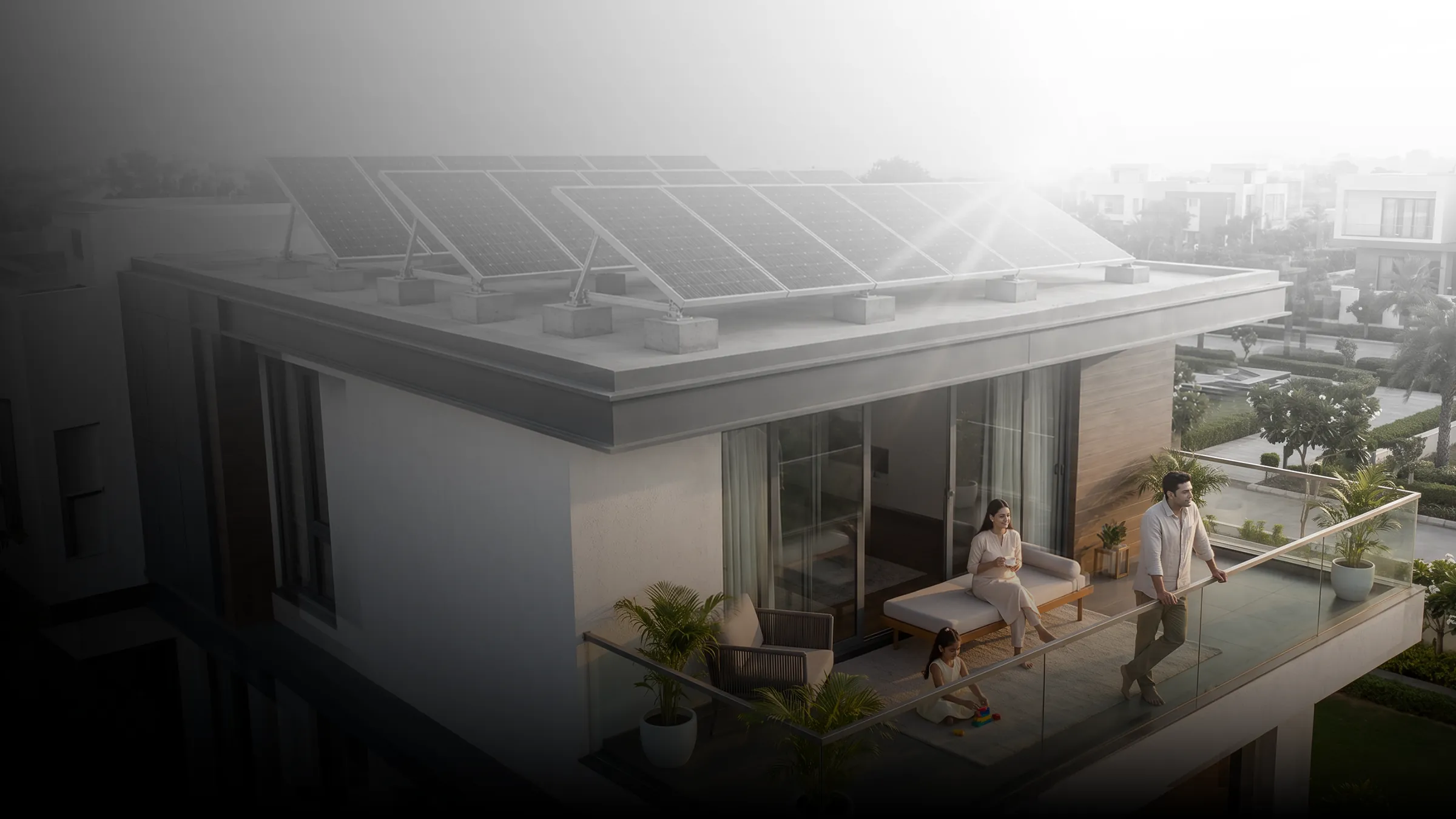

Reliable solar for homes and businesses.
Up to 90% off the electricity bill, PM Surya Ghar subsidy support, and every step from survey to commissioning done by Livguard's own engineers.
What do you pay a month?
A ₹3,000–6,000 bill usually takes about 7 kW — and solar covers up to 90% of it.
Indicative, from the sizes we fit most often. The survey is what turns it into a number for your roof.
Five jobs. One company answers for all of them.
Most rooftop solar is assembled from three vendors and a subcontractor, which is fine until something stops generating. Solar 360 is the whole chain under one name.
- Solution
- High-quality rooftop solar curated to your energy expectations — on grid, off grid and hybrid.
- SITC
- Survey, installation, testing and commissioning, through authorised experts rather than whoever is available.
- Service
- A pan-India solar service network covering 25,000+ pin codes.
- Screening
- Real-time monitoring of generation and savings through the LivMonitor 360 app.
- Support after install
- Monthly and quarterly AMC options, so generation holds up over the plant's life instead of quietly drifting down.
Same roof. Three very different answers.
The panels don't change. Where the power goes does — and that decides your bill, your backup and your budget. Read across.
The house we're sizing — a 3 BHK in Jaipur
₹4,200Bill a month 7 kWSystem 600 sq ftRoof used 4–6 hrsCuts a month| Attribute |
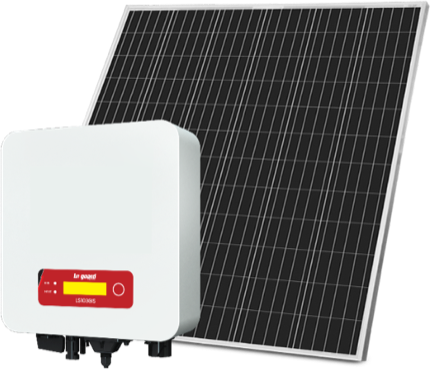 01On Grid Panels, an on grid inverter and a net meter |
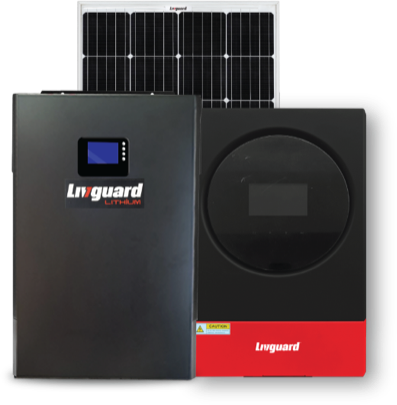 Best for this house 02Hybrid Panels, a hybrid inverter and solar batteries |
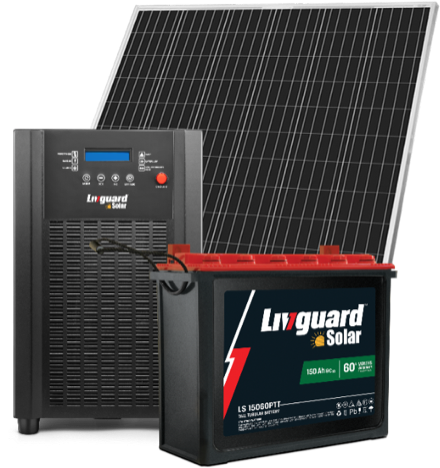 03Off Grid Panels, an off grid inverter and batteries |
|---|---|---|---|
| The extra power | Out to the grid. A net meter counts it back against what you draw after dark. | Into the battery first, then out to the grid once the battery is full. | Into the battery. Nothing is exported — there is nothing dependable to export to. |
| Backup in a cut | None. When the grid is down, the system is down. | Yes. The battery carries the house through the cut. | Yes. The battery is the supply, not the fallback. |
| Share of the bill | Up to 90% | Up to 90% | All of it — there is no bill to cut |
| Upfront cost | Lowest of the three — no battery to buy. | Higher — the battery is the difference. | Highest — it needs enough battery to run the house alone. |
| For this house | Cuts the bill, but leaves those 4–6 hours a month dark. | The pick. Same 90% off the bill, and the evening cuts stop mattering. | Wrong here — Jaipur has a grid worth selling back to. Right for a farm that hasn't. |
This house is a worked example on our own 3 BHK sizing preset, not a quotation, and the recommendation follows from its outage pattern rather than from a rule. The share of the bill a system covers depends on your roof, your shade and your consumption — which is what the free survey is for.
The government pays for part of your roof.
₹78,000
Central subsidy support under PM Surya Ghar: Muft Bijli Yojana. Up to ₹1,08,000 in states that add their own top-up.
- Who qualifies
- A residential rooftop with its own electricity connection and a sanctioned load the system can sit under. Our surveyor confirms it on site, free.
- What you get
- Subsidy support against the system cost, net metering set up with your DISCOM, and EMI options on the balance.
- Who files it
- We do. The application, the DISCOM paperwork and the inspection are handled by Livguard, not handed to you as a checklist.
The warranty, part by part.
"Twenty-five year warranty" is four different warranties on four different parts. Here is which is which.
Panel performance
The long one
The panel is warranted to still be generating a stated share of its rated output at year 27 — this is the figure the "25-year solar warranty" in the market is usually reaching for.
Panel, product
The panel itself
Against defects in the panel as an object — the glass, the frame, the junction box.
Solar inverter
The box on the wall
Standard cover on the inverter — the part that does the converting and the reporting.
The solution
Including the work
The installed system as a whole, including the installation — not just the boxes bolted to your roof.
Mounting structure
150 kmph
Not a warranty and not a duration, which is why it is off the scale: it is a rating. The MMS is built to hold the array in that wind.
Most common questions.
What is a solar power system?
A solar system converts sunlight into electricity using solar panels. The power generated runs household appliances, and excess power can be exported to the grid in on grid systems, which is what reduces the bill.
- Solar panels — capture sunlight and generate DC power
- Inverter — converts DC into the AC your appliances use
- Structure and wiring — holds the panels and keeps the power flowing safely
- Net meter — on grid only; tracks what you import and what you export
How is Solar 360 different from other brands?
Solar 360 is built for maximum generation with maximum safety across the whole system, not just the panel.
- Positive power tolerance solar modules
- A solar inverter with higher efficiency
- Mounting structure rated to withstand 150 kmph winds
- One supplier for the entire installation
Panels, inverters and batteries are designed and supported by Livguard, so there is no dependency on several vendors, and accountability is not something you have to establish before anyone will fix anything.
How much will my electricity bill drop?
Up to 90%, depending on the size of the system and your power usage. The survey is what turns that range into a number for your own roof and your own bill.
What does a rooftop plant cost?
It depends on system size and what is included — panels, inverter, structure, installation. Livguard runs a site survey and gives you a customised quote, so you have an exact price for your home or business before anything is installed. There are no upfront costs and no site survey charges.
PM Surya Ghar subsidy support of ₹78,000 applies to eligible residential rooftops, up to ₹1,08,000 in states that add a top-up. We file it for you.
How much maintenance does it need?
Very little. Clean the panels monthly — dust is the main thing that costs you generation — and keep the inverter in a dry, well-ventilated spot. With that, a system lasts well past 20 to 25 years. AMC options cover the cleaning and the checks if you would rather not think about it.
Book a free site survey.
An engineer comes out, measures the roof, reads your last bill, and tells you what fits. No charges, and no upfront cost to get a quote.
- Livguard nationwide service network
- 24/7 system monitoring and support
- Government subsidy assistance
- Net metering setup included
- 5 years solution warranty
Thank you for your interest.
Your request for a free solar consultation is in. Hang on — our team will get in touch with you shortly.
Your roof is ready before you are.
Book the survey and find out what it would make. No charge, no obligation, and an engineer rather than a call centre.